Web design28 Feb 2024· 8 min read
Web design: the principles of a great user experience
The UX foundations of a fast, accessible website that converts.
By Craftigital
UX as a competitive advantage
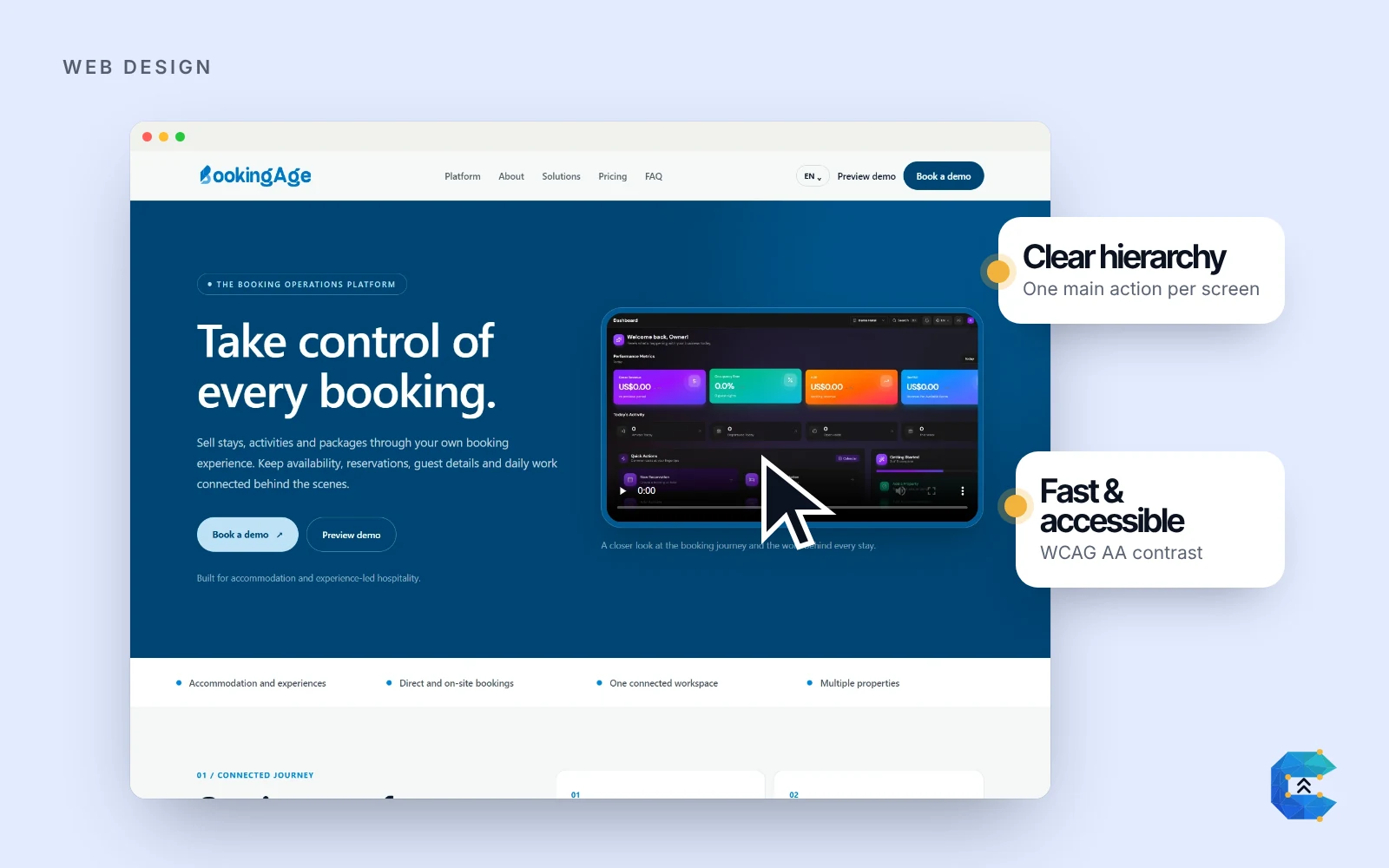
Solid UX lowers acquisition costs by speeding up activation and retention. It reduces the user's effort, makes the value clear and smooths the path to the next action.
1. Visual hierarchy and readability
- Enough contrast (WCAG AA or better)
- A harmonious type scale
- White space that structures
- Visible focus states
2. Perceived speed
Performance is how fast it feels: loading skeletons, smart lazy loading, conditional prefetching and compressed critical assets.
3. Accessibility as the default
Clear labels, contrast, full keyboard navigation, minimal ARIA, media alternatives. Each one widens your audience.
4. Feedback and micro-interactions
Subtle animation guides people. A hover state, a button that shows it's loading, step-by-step validation: everything makes the system's state clear.
5. Task-oriented journeys
- Map the main tasks
- Remove unnecessary fields
- Break complex actions into steps
- Build on familiar mental models
“The best interface is the one you don't have to explain.”
6. Continuous validation
Test early and often: moderated sessions, analytics events, heatmaps, micro-surveys. Turn the findings into a prioritised backlog.
Conclusion
Great UX is a cross-team discipline: it needs product, design and engineering aligned, and a steady improvement cycle.
Up next
Content marketing strategies for SMEs
View